
Slow down in order to speed up!
In my times as a business leader I was always proud about my action orientation and ability to take quick fact based decisions. When dealing with complexity standard paradigms of good leadership may fall short. Counterintuitively it may be required to slow down to speed up.
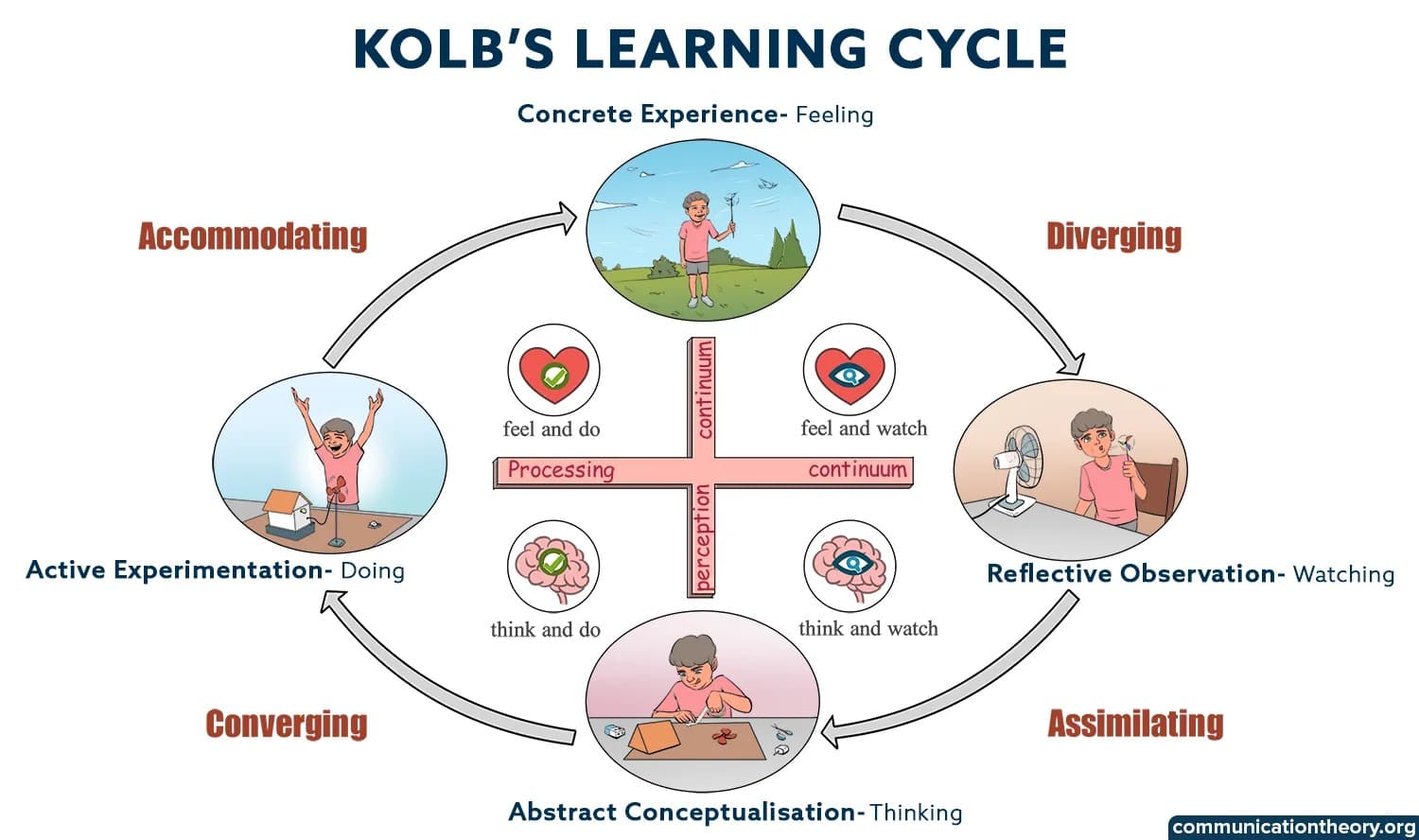
A look into the way humans learn can give us some direction about how to approach organisational learning in times of uncertainty and complexity.
The Kolb Experiential Learning Circle is a foundational model in educational theory that describes learning as a continuous, four stage process:
- Concrete Experience
- Reflective Observation
- Abstract Conceptualization
- Active experimentation.
It involves an element of diverging – opening of the funnel – before going into abstract conceptualisation and active experimentation and it includes a word that still is frowned upon in the business context – to feel and watch!
Take the time to feel and watch
Traditionally leadership would focus on the left hand side of the circle, going from the concrete experience of a situation to conceptualisation and active experimentation to come up with a quick potential solution to a challenge.
However this prevents leaders from seeing the full picture and may fall on their feet especially when complex challenges of collaboration are concerned.
Think about the following leadership challenge that was presented by Paul (not his real name) a supply chain leader during a peer coaching session. He talked about being in charge of global process standardisation and wanted to understand from the group how he could drive adoption in some remaining pockets of resistance. The peer group mirrored feelings of frustration and ambivalence and helped the presenter to uncover his own doubts about the neccessity to apply such a rigid approach. Seing his own ambivalence as an important data point helped Paul to reframe the challenge and see different perspectives and additional optional solutions.
One hour of peer reflection per month can make a big difference
Regular peer or team reflection circles can be very useful to help introduce structured time for reflection. It starts by allowing to share cases in a non-judgmental space and ecouraging expression of emotions and associations rather than jumping to solutions. One precious hour per month in a group of around 6 can already make a whole world of a difference.

Ähnliche Beiträge

Once you start the journey, you will see the signs!
How to start big tasks without getting overwhelmed
Jetzt lesen
Every complex problem has an answer that is clear simple and wrong
How to deal with increasing complexity in decision making
Jetzt lesen